Fujifilm Instax WIDE Evo Review
The instant camera that lets you keep the surprise—without wasting the shot
The Instax WIDE Evo is not trying to replace your phone or your mirrorless camera. It is built for something more emotional: turning an ordinary moment into a physical object—one you can hold, share, pin to a wall, or rediscover years later. Fujifilm’s clever hybrid design keeps that instant-camera magic while removing its most expensive frustration: you decide which frames deserve to be printed.

A modern camera with an analogue heart
Instant photography has always been a beautiful bargain. You accept limited control, unpredictable results and a relatively high cost per frame in exchange for a photograph that appears in the real world. The Instax WIDE Evo changes the terms without breaking the spell. It is a digital camera and an Instax WIDE printer in one body: compose on the rear screen, capture the image, review it, and then turn the print crank only when you are ready to commit.
That select-before-you-print workflow matters. Instax WIDE film comes in ten-shot packs, so every avoided blink, accidental frame or badly timed expression saves real money. More importantly, it encourages experimentation. You can explore the camera’s effects freely, keep the digital files, and reserve the film for the images that carry a story.
The concept follows the successful Instax mini Evo, but the WIDE Evo feels more ambitious. The larger print format gives group photographs, landscapes and environmental portraits room to breathe. Compared with the small, charming mini print, the WIDE frame feels more like a photograph you might display rather than a keepsake you tuck into a wallet.
Design: large, tactile and deliberately theatrical
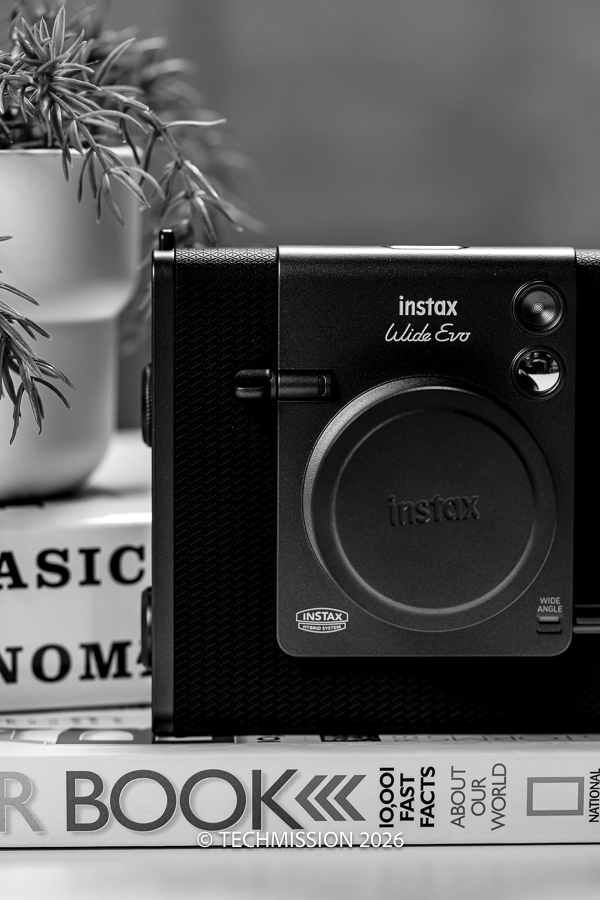
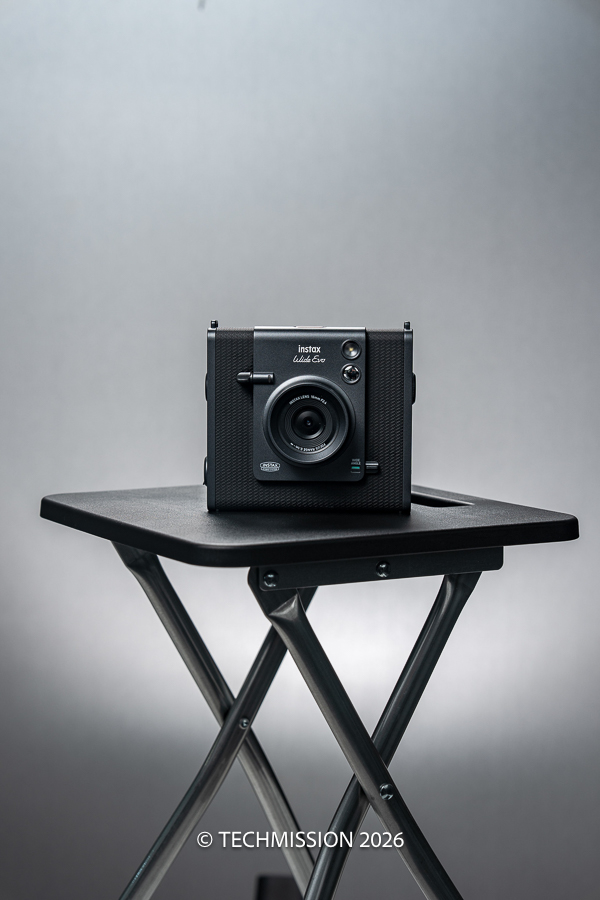
At roughly 490g before film and memory card, this is not a pocket camera. Yet it is smaller and more refined than the analogue Instax WIDE 400, and its black-and-grey finish gives it a mature, premium identity. The materials feel considered, the controls are satisfyingly mechanical, and the camera looks more like a creative instrument than a brightly coloured party accessory.
The theatre is intentional. A dial on each side controls the lens and film effects. A ring around the lens adjusts the strength of the chosen treatment. The shutter lever requires a half-press to focus and a full press to capture. Best of all, printing begins by rotating a physical crank on the side—a playful echo of advancing film in an old camera. None of this is mechanically necessary, but all of it makes the process memorable.
The rear is dominated by a 3.5-inch, approximately 460,000-dot LCD. There is no viewfinder, so every photograph is composed on this screen. The interface is straightforward, with a small selector, playback and menu controls beneath the display. On top, the print emerges from the film slot, while a dedicated Film Style button adds a further layer of presentation.
A selfie mirror sits beside the lens, the flash is positioned above it, and a tripod socket is pushed towards the edge of the base to make room for the printer mechanism. USB-C is present, but only for charging the internal battery; it does not transfer photographs. A microSD/microSDHC slot is hidden behind the side cover—and using a card is strongly recommended.
The lens changes the character of Instax
The WIDE Evo uses the widest lens yet fitted to an Instax camera: a 16mm-equivalent f/2.4 lens. That field of view is dramatic. It welcomes architecture, rooms, travel scenes, crowded tables and groups of friends into the frame. It also brings the familiar perspective exaggeration of an ultra-wide lens, especially when faces are close to the edges. This is not a conventional portrait lens, and that is part of its personality.
A Wide Angle switch lets the camera use the full field of view or apply a tighter digital crop. The crop is useful when the scene does not need so much space, but it cannot change the optical behaviour of the lens. You still need to be thoughtful about distance and positioning if you want faces to look natural.
Autofocus is simple rather than sophisticated, with single AF and optional face detection. In everyday use it is responsive enough for the camera’s purpose. A macro option lets you focus as close as 10cm, while the small built-in flash can add exactly the kind of direct, nostalgic punch that suits an instant print.
One hundred effects—and then another layer
Creativity is the centre of the WIDE Evo experience. The left dial offers ten lens effects: Normal, Light Leak, Light Prism, Vignette, Soft Glow, Double Exposure, Color Shift, Monochrome Blur, Color Gradient and Beam Flare. The right dial adds ten film effects: Normal, Vivid, Warm, Sky Blue, Light Green, Magenta, Sepia, Monochrome, Amber and Summer.
Because the two groups can be combined, the camera offers 100 base combinations. The degree-control ring then lets you soften or intensify the lens effect, making the same combination feel restrained in one frame and deliberately dramatic in the next. It is a tactile, immediate system: turn, preview, adjust and shoot.
Six Film Styles add a presentation layer: Normal, Cinematic, Date Stamp, Collodion Process, Contact Sheet and Film Strip. These can make a photograph feel like a widescreen movie still, an archival plate, a dated snapshot or a strip of negatives. Used carefully, they give the print a convincing identity. Used on every frame, they can become gimmicky. The pleasure lies in matching the treatment to the moment.
There is one important limitation: the chosen look is baked into the captured JPEG. The WIDE Evo does not record RAW files, and its effects cannot be removed later. If a moment matters, it is worth taking one clean frame before experimenting.
Image quality: judged by the print, not the pixel
Fujifilm gives the WIDE Evo a 1/3-inch CMOS sensor and, in Wide Angle mode with a microSD card inserted, a maximum output of 4608 × 3456 pixels—about 16 megapixels. Other capture conditions produce 2560 × 1920 files, or about 5 megapixels. The internal memory holds approximately 45 images and records at the lower resolution; with a card installed, Fujifilm estimates around 280 full-resolution wide images or 850 lower-resolution images per gigabyte.
On a computer monitor, these files will not compete with a modern flagship phone. Dynamic range is modest, fine detail can look processed, and low-light noise is visible. But that comparison misses the design brief. The WIDE Evo’s image pipeline is tuned to create attractive Instax prints, where the format, colour, contrast and physical texture matter more than microscopic sharpness.
Seen that way, the results make sense. The camera produces photographs with a gently imperfect, nostalgic character, and the WIDE print gives those images presence. Skin tones, flash-lit interiors, summer scenes and graphic architecture can look especially charming. This is not technical image quality in the conventional camera-review sense; it is aesthetic cohesion between camera, effect and print.
Printing and the app
The print workflow is wonderfully simple. Choose an image, confirm it, rotate the crank and wait. Fujifilm quotes an output time of about 16 seconds, after which the image continues developing in the familiar Instax way. A full charge is rated for roughly 100 prints, although real-world results depend on shooting, wireless use and temperature.
The WIDE Evo also doubles as a wireless smartphone printer. Through the dedicated app, it can print JPEG, PNG and HEIF images from your phone, trigger the camera remotely, update firmware, and transfer images that have already been printed. That last condition is a notable restriction: the app is not a completely open wireless pipe for every photograph stored in the camera. If you want reliable access to the original files, a microSD card is the better route.
There is a larger creative benefit to the printer function. Your best phone photographs no longer have to remain trapped in a camera roll. Portraits, travel images and family pictures can become WIDE prints even if they were captured on another device. In that role alone, the camera has value after the novelty of shooting with it has settled.
What it is like to live with
The WIDE Evo is at its best when photography is social. Bring it to a birthday, a family lunch, a road trip or a weekend gathering and the print becomes part of the event. People gather around the screen, debate which version looks best, watch the image emerge, and often hand the finished photograph to someone before the evening ends.
Its constraints create a healthier rhythm than phone photography. You shoot fewer meaningless duplicates, spend more time choosing, and give the best frames a destination. The camera can also produce visually distinctive material for social media, especially when the digital image is shared with its Instax-style border, but the physical print remains the point.
There are irritations. The body is bulky, the screen is the only way to compose, USB-C cannot transfer data, app-based camera transfers are restricted, and the controls take a little time to learn. The film door also deserves respect: opening it before a pack is finished can expose and ruin the remaining sheets.
Who should buy it?
At around $350 at launch, the Instax WIDE Evo is a premium instant camera. It makes sense for someone who values the WIDE format, enjoys creative effects, wants to avoid wasting film, and likes the idea of a camera that also serves as a smartphone printer. It is especially compelling for families, travellers, event hosts, scrapbookers and creators who want a physical output without giving up digital convenience.
It is a weaker choice for buyers seeking a compact everyday camera, manual photographic control, interchangeable looks in post-production, or files that can replace a phone or dedicated digital camera. It also demands an ongoing film budget, which should be considered part of the experience rather than a hidden accessory cost.
TECHMISSION Recommends
Where to Buy the Fujifilm Instax WIDE Evo
Some links are affiliate links — TECHMISSION may earn a commission at no extra cost to you. See our affiliate disclosure.
Verdict
The Fujifilm Instax WIDE Evo succeeds because it understands that instant photography is not really about speed. It is about ceremony. The dials invite you to play, the screen lets you avoid expensive mistakes, the crank turns printing into an event, and the larger WIDE frame gives the final image enough space to matter.
Its digital files are ordinary and some connectivity choices feel unnecessarily restrictive. Yet as a machine for making tangible memories, it is unusually convincing. The WIDE Evo does not ask to be your only camera. It asks to be the camera you bring when you want the photograph itself—not just the act of taking it—to become part of the memory.
Key specifications
| Sensor | 1/3-inch CMOS; up to 4608 × 3456 pixels |
| Lens | 16mm equivalent, f/2.4 |
| Focus range | 10cm to infinity; face-detection AF available |
| Display | 3.5-inch TFT LCD, approximately 460,000 dots |
| Storage | Internal memory plus microSD/microSDHC |
| Creative tools | 10 lens effects, 10 film effects, 6 Film Styles |
| Printing | Instax WIDE film; approximately 16-second output |
| Battery | Built-in lithium-ion; approximately 100 prints per charge |
| Size and weight | 138.7 × 125 × 62.8mm; approximately 490g |