Peak Design Roller Pro Review: The Carry-On That Understands Photographer, videographer, and Creators
After years of travelling with camera rollers from some of the industry’s most respected brands, I took the Peak Design Roller Pro on a real production trip. Its smartest ideas are not the ones that look impressive in photographs—they are the ones that make airports, flights and location work noticeably easier.
I have used enough camera bags to know that choosing one is never simply about capacity. When I travel for a production, whether to Kenya, Georgia, Saudi Arabia or somewhere closer to home, the first priority is protecting the equipment that makes the trip possible.
Over the years, I have travelled with rollers from Manfrotto and Think Tank, among others. Some have been excellent. But after taking the Peak Design Roller Pro on a working trip, I believe I have found my main travel roller for the next several years.
That is a strong conclusion for a bag costing around $600, but the Roller Pro earns it through more than premium materials. It solves several familiar problems with genuinely intelligent design—and those solutions continued to make sense after the bag left the studio and entered a busy airport.
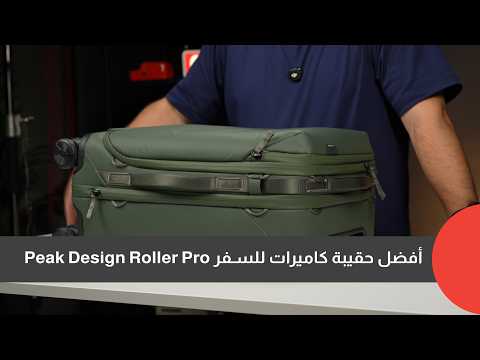
From the field
See the Peak Design Roller Pro in real-world use on Instagram
My first real test: a production trip through Riyadh
A roller can look exceptionally clever during an indoor demonstration and still become irritating once it is loaded, rushed through a terminal and repeatedly opened during a working day. That is why my first production trip with the Roller Pro mattered more than any initial inspection.
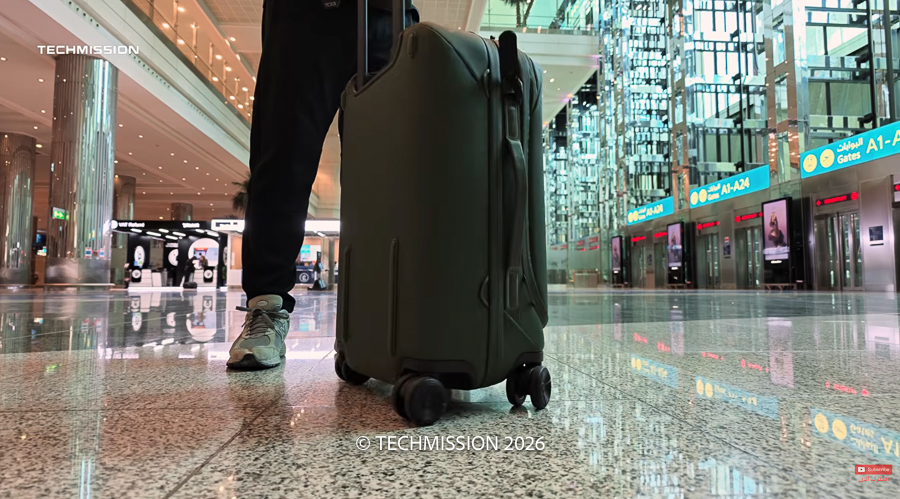
I travelled with it from Dubai to Riyadh on Emirates, carrying my camera equipment and the other essentials needed for the assignment. Its dimensions—approximately 55.5 × 35.5 × 23cm—worked as cabin luggage on that journey, and the airline raised no issue with the bag.
That should not be treated as a guarantee for every flight. Cabin dimensions and, more importantly, weight allowances vary between airlines. Photographers can reach a weight limit surprisingly quickly once several bodies and lenses are packed. Nevertheless, the Roller Pro’s physical size is clearly intended for overhead travel, and it passed my real-world test without drama.
The assignment itself took me into a factory where cutting and other industrial work filled the environment with dust. By the end of the job, the exterior looked suitably well travelled. A simple wipe-down brought it back into shape, with no lasting problem.
The more important result was how the bag behaved in motion. Its wheels were exceptionally smooth across the airport—almost too smooth when the floor sloped away from me. The handle felt solid and comfortable, and the internal organization worked exactly as I needed it to.
Most of all, the unusual opening became more valuable every time I used it.
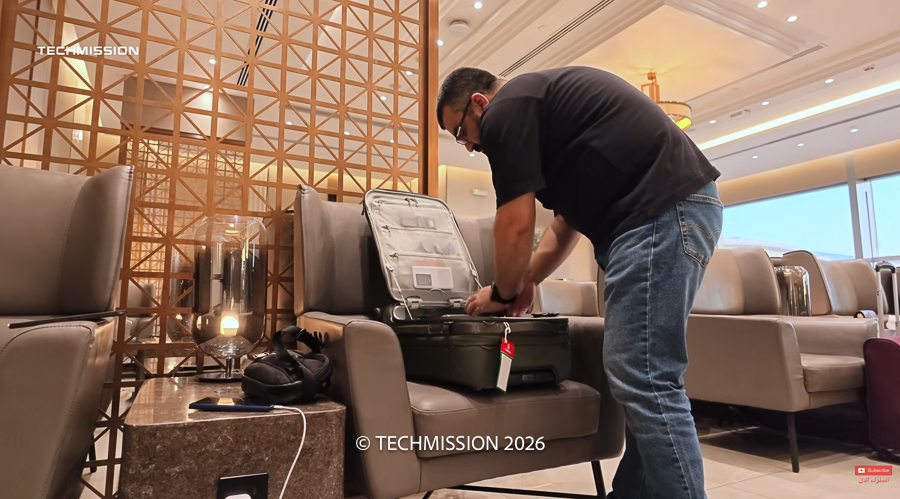
The drawbridge opening is not a gimmick
Most rollers open in one of two ways. A traditional clamshell divides the case through the middle, while some equipment bags use a large lid that opens from one edge. Both designs often demand more floor space than you really have.
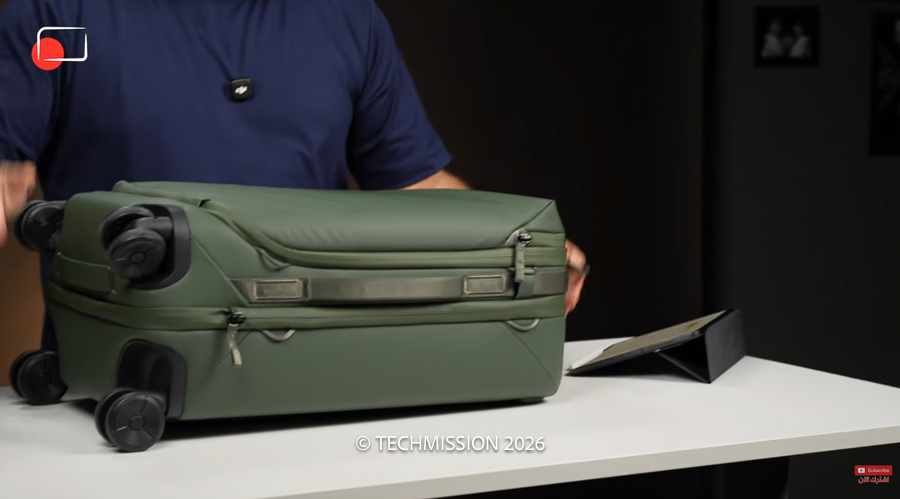
The Roller Pro takes a different approach. Its upper section opens like a drawbridge and is held at an angle, giving me a clear view of the interior without requiring the entire bag to lie fully open on the floor.
That distinction sounds small until you need something at an airport.
I could stand the roller beside me, open the upper section and reach the equipment I needed without spreading the bag across a busy walkway. During the trip, I repeatedly opened and closed it this way, and the design proved genuinely practical rather than merely different.
The same was true of the outer access. Whenever I needed my laptop or another travel essential, it was immediately available. At security, the quick pocket also gave me a sensible place for the small items that usually create confusion—my phone, keys, passport or watch—rather than forcing me to scatter them among trays and jacket pockets.
This is where Peak Design is at its best. The company has not simply added more pockets. It has paid attention to the exact moments when travellers need those pockets.
A hybrid shell gives protection without wasting flexibility
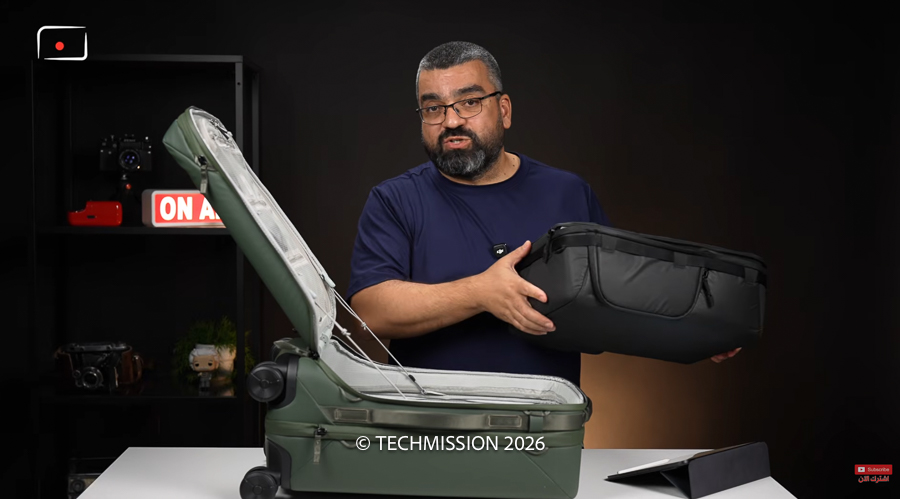
The Roller Pro sits between a conventional soft case and a fully rigid hard-shell suitcase. A structured polycarbonate interior provides the protective foundation, while the outside uses Peak Design’s recycled, Bluesign-approved 550D Versa Shell fabric. Layers of foam and felt add further protection around the contents.
In practice, this hybrid construction gives the bag a reassuringly solid base without making every surface completely inflexible. It feels protective enough for valuable equipment but remains more adaptable—and visually more refined—than a typical moulded plastic case.
I also appreciate the restrained branding. Peak Design’s name and initials are present, but they do not dominate the exterior. This is expensive professional luggage, yet it does not insist on announcing itself from the other side of the terminal.
The weather-resistant exterior and strong UltraZips are also consistent with my previous experience of Peak Design bags. On an earlier trip to the Maldives, one of the company’s backpacks was caught in severe rain and wind while carrying my cameras. I trusted the protection then, and that history made me more comfortable placing the same responsibility on the Roller Pro.
The carbon-fibre handle changes more than the appearance
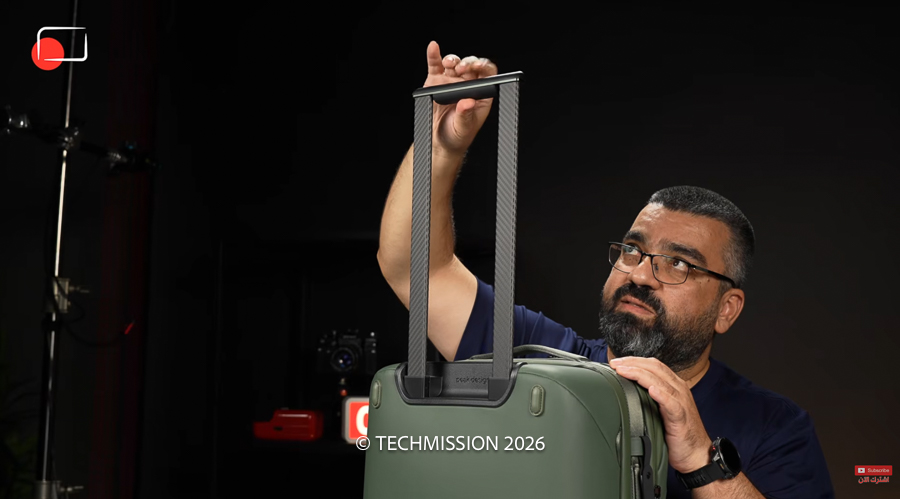
One of the Roller Pro’s defining features is its SlimDrive trolley system. Instead of the usual wide telescoping aluminium tubes, it uses two exceptionally thin 7mm carbon-fibre supports with an anodized aluminium grip. Peak Design provides two operating heights, approximately 90cm and 100cm.
The handle rises and lowers smoothly, feels firm in use and avoids the loose rattling that develops in many conventional luggage handles. More importantly, those slim supports occupy far less room inside the case.
Traditional telescoping tubes usually create two large channels along the interior floor. Manufacturers then hide them beneath fabric, but the lost space remains lost. Here, the carbon-fibre supports are narrow enough to be left visible against the felt lining, producing a flatter and more useful packing area.
This is an excellent example of a premium material being used for a practical reason. The carbon fibre is not there simply to justify the price or decorate a specification sheet. It improves the rigidity of the handle while returning valuable internal space to the owner.
Peak Design says the Roller Pro contains 154 custom parts, and the handle is the clearest demonstration of what that unusually ambitious approach achieves.
The wheels are superb—and designed for the long term
The Roller Pro uses four wheel assemblies, with two wheels in each assembly. The result is smooth, quiet movement in every direction. During my airport test, the bag followed with almost no resistance; on a smooth or slightly inclined floor, it could happily continue moving without me.
What matters over the longer term is that the 60mm wheel assemblies are replaceable. If one eventually wears out or is damaged, it can be removed with a small screw and replaced without sending the entire suitcase away for repair.
That matters on a product intended to last. Wheels are wear items, no matter how well they are made. A premium suitcase becomes difficult to defend if a single damaged wheel turns the whole product into waste.
Peak Design backs the Roller Pro with its lifetime guarantee. Combined with user-replaceable wheels, that gives the promise more practical meaning than a line printed on the packaging.
The grab handles deserve attention too. They are positioned around the case so that I can lift or pull it regardless of which way it is sitting. When a heavy roller is turned sideways in an overhead compartment, having a grip within reach is not a decorative detail—it is the difference between a controlled lift and an awkward struggle.
It can be a camera case, a travel case or both
The Roller Pro offers 34 litres of internal capacity in its standard configuration, expanding to approximately 39 litres when additional space is needed.
For camera equipment, I prefer using it in its more compact form. Expansion is more useful when the Roller Pro is serving as conventional luggage and I need room for clothing or other less delicate items.
Inside, an adjustable retention system can secure or compress the load. It works well for packing cubes, clothing and bulky pieces such as a winter jacket. When it is not needed, it can be tightened out of the way.
The lid contains three semi-transparent organization pockets. They offer enough visibility to identify their contents without exposing everything immediately. The larger panel can also be rolled and secured into what Peak Design playfully calls the “burrito position,” creating a more open packing area.
There is also a concealed pocket for valuables and a dedicated location for an Apple AirTag. None of these details transforms the bag independently, but together they show how thoroughly Peak Design has considered the way people actually travel.
The Camera Cube turns it into a complete creator system
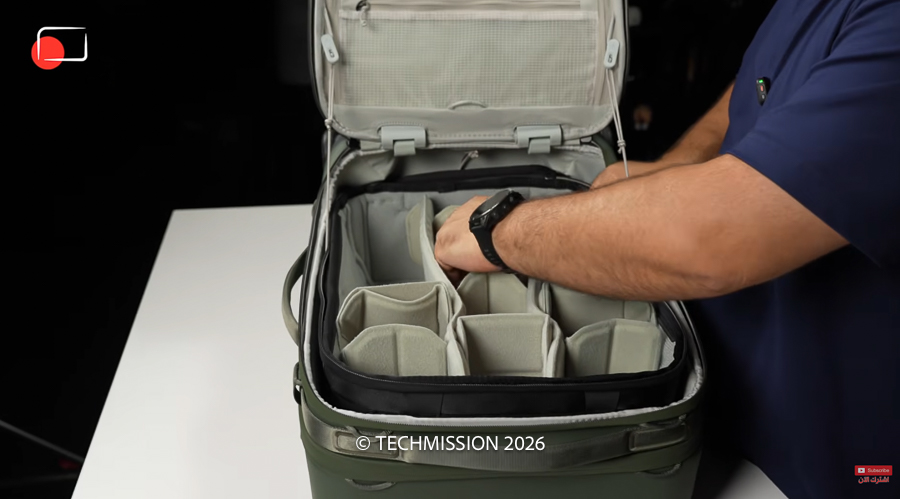
The Roller Pro is not permanently divided as a camera case. Instead, it works with Peak Design’s modular Camera Cubes, including an XL model shaped specifically for the roller.
The cube can be secured inside and organized with Peak Design’s familiar FlexFold dividers. Smaller cubes can be used when I want to carry a limited camera kit beside clothing and personal items.
There are two major advantages to this approach.
First, the same roller can adapt to different trips. I can fill it with camera equipment for a major production, use a smaller cube for a short assignment, or remove the camera storage completely and treat it as an ordinary carry-on.
Second, the cube becomes an escape plan if cabin space runs out. If an airline unexpectedly requires the roller to be checked at the gate, I can remove the cube and keep the cameras with me rather than surrendering the entire kit.
The modular system continues after arrival. I can move the loaded Camera Cube from the Roller Pro into a compatible Peak Design backpack, preserving the organization of the equipment rather than transferring every body, lens and accessory individually.
That creates a coherent workflow: the roller handles airports and flights, while the backpack handles the location. The equipment remains protected and organized as it moves between them.
What is not perfect?
The most obvious objection is the price. At roughly $599.95 before any current regional promotion, the Roller Pro belongs firmly in premium territory. The dedicated XL Camera Cube is also sold separately, adding both cost and weight if the objective is a full professional camera setup.
The Camera Cube’s added weight is not trivial when an airline enforces a strict cabin limit. The protection is valuable, but every photographer will need to balance that protection against the amount of equipment being carried.
The laptop area also presents one small compromise. In one of my Think Tank rollers, I had separate spaces for a laptop and a tablet. Here they share a single main sleeve. I can place both together, but I would prefer independent compartments.
In reality, this limitation has made me question whether I need to carry an iPad at all. I often bring one and barely use it. Still, creators who routinely travel with both devices should know that the organization is less separated than it could be.
There is also no wheel brake. Given how freely the Roller Pro moves, I would keep a hand—or a foot—on it when standing on a sloped airport floor.
Finally, although the construction feels extremely promising and the replaceable components inspire confidence, one production trip cannot prove how every material will look after five or ten years. My expectation is optimistic, but genuine long-term durability must be earned over time.
Peak Design Roller Pro key specifications
| Specification | Details |
|---|---|
| External dimensions | Approximately 55.5 × 35.5 × 23cm |
| Standard capacity | 34 litres |
| Expanded capacity | Approximately 39 litres |
| Construction | Hybrid polycarbonate structure with recycled 550D fabric exterior |
| Trolley system | SlimDrive with 7mm carbon-fibre supports |
| Handle heights | Approximately 90cm and 100cm |
| Wheels | Four replaceable 60mm dual-wheel assemblies |
| Opening | Space-saving drawbridge design |
| Camera storage | Compatible with modular Peak Design Camera Cubes |
| Warranty | Peak Design lifetime guarantee |
| List price at time of writing | Approximately $599.95; regional pricing and promotions vary |
Who should buy the Roller Pro?
The Roller Pro makes the most sense for photographers, filmmakers and other travelling creators who regularly carry valuable equipment and are already comfortable investing in a modular bag system.
It is especially compelling for someone who wants one premium roller to move between three roles:
- a protected camera carry-on;
- a hybrid case for equipment and clothing;
- a conventional travel roller when no camera kit is required.
Occasional travellers may find the price difficult to justify. A less expensive roller can still carry equipment successfully, particularly if it spends most of its life in storage.
Frequent travellers, however, interact with their luggage constantly: at security, at the gate, in overhead compartments, inside taxis and on location. In that context, better wheels, faster access, more usable interior space and replaceable wear components are not luxuries in the abstract. They improve every stage of the working day.
TECHMISSION Recommends
Where to Buy the Peak Design Roller Pro
Some links are affiliate links — TECHMISSION may earn a commission at no extra cost to you. See our affiliate disclosure.
Verdict: expensive, ambitious and exceptionally well resolved
The Peak Design Roller Pro is one of the finest combinations of travel luggage and camera transport I have used.
Its biggest success is not any single headline feature. It is the way the decisions reinforce one another. The slim carbon-fibre handle releases internal space. The drawbridge opening reduces the room needed for access. The modular Camera Cube protects equipment while allowing it to move into a backpack. The quick pocket makes airport security easier. Replaceable wheels support the promise of long-term ownership.
I went into the trip expecting impressive design. I returned appreciating how little I had needed to think about the bag itself. It rolled beautifully, fitted into the journey without trouble, kept essential items close and gave me immediate access whenever the work demanded it.
That is what professional equipment should do.
The Roller Pro is expensive, and it asks buyers to commit to Peak Design’s modular approach if they want the strongest camera workflow. But it also feels like a product created by people who were dissatisfied with the inherited rules of luggage design and were willing to reconsider nearly every component.
For my own travel, it has become the new reference point—and, unless something genuinely better appears, the roller I expect to rely on for years.
Technical details were checked against Peak Design’s official Roller Pro product information and design overview. Price and availability may vary by country and date.