What Camera Should You Buy? A Guide by Photography Genre
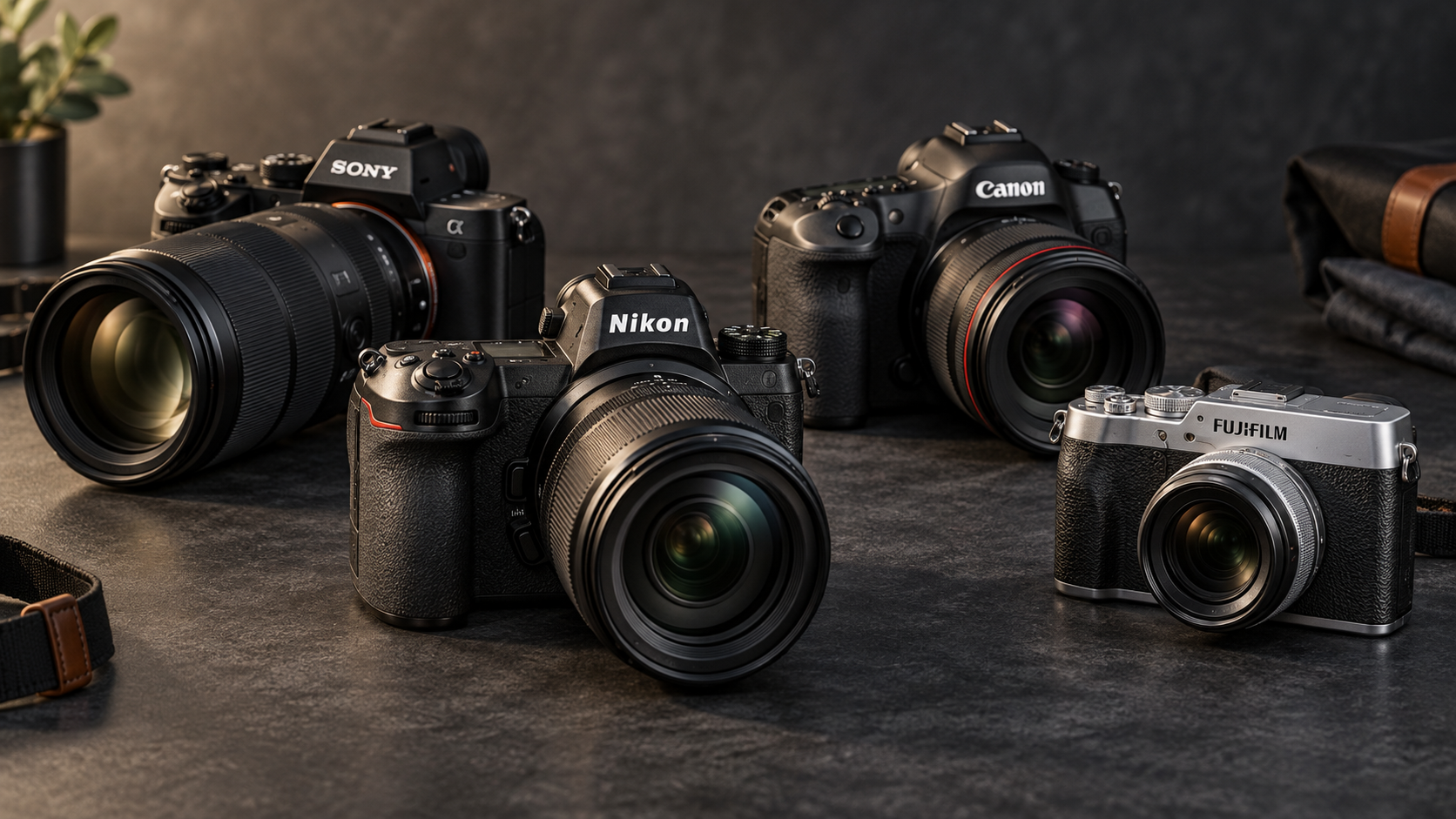
The right camera depends on what you photograph. Here are our recommendations from Nikon, Sony, Canon, and Fujifilm, with the features that make each one worth considering.
The Sony A9 III gets our vote for demanding action photography, the Sony A7R VI leads our high-resolution portrait choices, and the Nikon Z6III is our first recommendation for travel and versatile photo/video work.
However, there is no single camera that represents the best purchase for everyone. Wildlife photographers need tracking and reach. Portrait photographers need accurate focus, suitable lenses, and enough detail for their clients. Wedding photographers need a dependable system that works quickly through changing light.
This guide prioritizes those practical differences. The rankings reflect our preferred combinations of capability, handling, and value.
Wildlife and sports: speed matters, but so does keeping the subject in view
For wildlife and sports, look for reliable subject detection, continuous autofocus, fast sensor readout, and a buffer that can sustain a useful sequence. A clear viewfinder helps you follow unpredictable movement, while resolution gives you room to crop distant subjects.
Burst-rate claims also need context. A camera’s fastest mode may use JPEG rather than raw, reduce resolution, or require particular lenses and settings.
Sony A9 III: the edge for capturing fast action
The A9 III’s defining feature is its global shutter, which captures the entire sensor simultaneously. Conventional electronic shutters read the image progressively, potentially distorting fast-moving objects. The Sony avoids that rolling-shutter effect, making it particularly attractive for swinging bats, moving wings, and rapid panning.
It also shoots up to 120fps with autofocus and exposure tracking. That gives a photographer more positions to choose from during a brief action sequence. Pre-capture can retain images from before the shutter button is fully pressed, helping with moments such as a bird suddenly taking flight. Maximum performance depends on compatible equipment and settings. Sony A9 III
Its approximately 24.6MP resolution is sufficient for many professional uses, but offers less cropping flexibility than the higher-resolution cameras below. The A9 III earns its position when the priority is capturing the exact moment cleanly.
Nikon Z9: flagship features with a compelling value argument
The Z9 combines a 45.7MP stacked sensor with Nikon’s EXPEED 7 processor, subject recognition, and 3D Tracking. For wildlife, that resolution leaves useful room to crop when you cannot safely or practically move closer.
Its blackout-free viewfinder is equally relevant. You can continue following a bird or athlete during a burst, helping you keep the subject properly framed. It captures full-resolution raw files at up to 20fps; the headline 120fps mode records lower-resolution, 11MP JPEGs.
The integrated vertical grip makes portrait-orientation sports shots more comfortable, while the large battery and dual CFexpress Type B slots support extended assignments. Its fast readout suppresses rolling-shutter distortion, although it does not use a global shutter. Nikon Z9 specifications
The appeal is the combination: resolution, speed, professional handling, and endurance in one body. It is a strong purchase for photographers who want flagship capability and find it priced below competing flagships. Compare current local offers, because promotions can materially change that value equation.
Nikon Z8: the budget option within this professional shortlist
The Z8 retains the central attraction of the Z9: a 45.7MP stacked sensor, EXPEED 7 processing, sophisticated autofocus, and a blackout-free viewing experience. That makes it a serious action camera rather than a modest body with a high-resolution sensor.
Its smaller design is useful when following wildlife on foot or repeatedly raising a long lens. Nikon describes it as approximately 30% smaller than the Z9. You gain portability while retaining much of the flagship’s core performance. Nikon Z8 announcement
The practical compromises are its smaller battery, lack of an integrated vertical grip, and mixed CFexpress Type B/SD card arrangement. Those differences matter more during demanding all-day assignments than a short wildlife outing. Nikon Z8
For many photographers, the Z8 is the smarter allocation of money. A saving on the body can help fund a suitable telephoto, such as Nikon’s NIKKOR Z 180–600mm f/5.6–6.3 VR. Its zoom range helps frame animals at changing distances. Nikon Z lenses
Sony A1 II: the expensive jack of all trades
The A1 II combines 50.1MP resolution with shooting up to 30fps and AI-assisted subject recognition. The resolution helps with distant wildlife, while the speed supports sport and unpredictable movement.
Its improved stabilization and professional feature set also suit assignments beyond action. That breadth is the reason to buy it: one camera can cover wildlife, portraits, commercial photography, and demanding video work. Sony A1 II
It is an expensive purchase, but its versatility can make sense for photographers whose work spans several genres.
Canon EOS R5 Mark II: resolution and action in one body
The R5 Mark II pairs a 45MP stacked sensor with up to 30fps electronic-shutter shooting. Its resolution gives wildlife photographers room to crop, while the faster sensor readout helps control distortion during action.
Its subject-tracking system and Eye Control AF offer different ways to acquire a subject. Eye Control can help direct the focus selection toward where the photographer looks, although its usefulness depends on calibration and individual performance. Canon EOS R5 Mark II
It is a strong choice for Canon photographers who need both fast action and detailed files for other assignments.
Canon EOS R3: built around the sports photographer
The R3’s 24.1MP stacked sensor and up to 30fps shooting favor speed and more manageable files. Smaller files can be useful when selecting, editing, and transmitting large numbers of images under deadline.
Its integrated vertical grip suits long periods of shooting athletes in portrait orientation, and its subject detection helps maintain focus on moving people, animals, and vehicles. Canon EOS R3
Choose it when professional handling and efficient delivery matter more than substantial cropping.
Canon EOS R1: specialist capability at a difficult price
The R1 offers a 24.2MP stacked sensor, up to 40fps electronic-shutter shooting, and advanced autofocus features designed around professional action coverage. Its cross-type autofocus and sports-oriented subject prioritization address situations where maintaining the right subject is critical. Canon EOS R1 announcement
Those features have real value for specialist sports and news photographers. For most buyers, however, the premium is difficult to justify when the R3 and R5 Mark II already cover so much ground. Our reservation concerns the return on the investment.
Portrait photography: resolution helps, but focus and lenses shape the result
Portrait cameras need dependable eye detection, pleasing tonal rendering, and access to suitable lenses. High resolution benefits detailed retouching, commercial beauty work, and large prints. Moderate resolution often provides everything required for family sessions, headshots, and everyday client delivery.
Accurate focus becomes particularly important with wide-aperture lenses, where the depth of field can be very shallow.
High-resolution options
Sony A7R VI: our first choice for detail-focused portraits
The A7R VI’s approximately 66.8MP full-frame sensor gives photographers substantial detail for skin, hair, fabric, and commercial retouching. It also allows different crops from one composition, useful when a client needs both a wide layout and a tighter portrait.
Its fully stacked sensor and subject-recognition autofocus extend its usefulness to moving subjects, including walking models and expressive fashion sessions. Sony A7R VI
The A7R V remains a good alternative. Its 61MP sensor already delivers considerable detail, and its eye-recognition capabilities suit controlled portrait work. If the price difference is substantial, the older camera can leave more money for lenses and lighting. Sony A7R V
Nikon Z9: a strong portrait camera with an excellent lens system
The Z9 suits photographers who want detailed portraits and professional handling, particularly when their work also includes movement. Eye detection helps maintain focus as a subject changes pose, reducing the need to keep manually repositioning a focus point. Nikon’s portrait examples demonstrate its use with both native and adapted lenses. Nikon Z9 portrait applications
The lens selection is a major part of its appeal. The NIKKOR Z 85mm f/1.2 S offers a wide aperture for isolating a subject against a soft background. That can be especially effective in environmental portraits where the setting should remain recognizable without competing for attention. Nikon 85mm f/1.2 S
The NIKKOR Z 135mm f/1.8 S Plena provides a longer working distance and emphasizes smooth foreground and background blur. It is particularly appealing for outdoor portraits where there is room to step back. More accessible Nikon and third-party primes let photographers build the system at different budgets. Nikon Plena, Viltrox Z-mount option
The Z9 makes the strongest case when its professional body and broader capabilities will be used regularly.
Sony A1 II: portraits alongside demanding assignments
The A1 II’s high resolution provides room for retouching and cropping, while its advanced autofocus helps when portraits involve movement. Think of an athlete performing a movement or a model walking toward the camera.
Its versatility is its main attraction. A photographer working exclusively with posed portraits may find better value in the A7R series; someone combining portraits with sports and video has more reason to choose the A1 II.
Canon EOS R5: still a capable high-resolution purchase
The original R5 offers a 45MP sensor, eye-detection autofocus, and in-body stabilization. Eye detection helps with precise focus at wide apertures, while stabilization can assist handheld photographs of relatively still subjects.
Its resolution remains useful for large prints and commercial work. Bought at the right price, it allows a photographer to invest in high-resolution portrait capability without paying for the R5 Mark II’s newer action features. Canon EOS R5
More budget-friendly full-frame options
Nikon Z6III: our top recommendation for a balanced portrait system
The Z6III combines a 24.5MP partially stacked sensor with subject recognition and 3D Tracking. That resolution is practical for client galleries and prints, while keeping a large session easier to handle than one shot entirely at much higher resolution.
The partially stacked design speeds up readout. Its benefit is most relevant when photographing children, candid expressions, and moving subjects; it should not be mistaken for an automatic improvement in skin tones or dynamic range. Nikon Z6III
The bigger buying argument is access to Nikon’s portrait lenses without the cost of a flagship body. A NIKKOR Z 85mm f/1.8 S makes a sensible starting point, while the 85mm f/1.2 S and Plena remain future options. Nikon lens range
This is a camera that can start with everyday portraits and remain useful as the work expands into weddings, events, and video.
Sony A7 V: useful resolution and a broad lens choice
The A7 V’s 33MP partially stacked sensor offers a middle ground between moderate-resolution bodies and the larger files of the A7R series. That gives room to refine framing without imposing the same storage demands.
Subject-recognition autofocus is useful when a person changes position or turns their head, allowing the photographer to concentrate on expression and composition. Sony A7 V
Sony’s own portrait primes and third-party E-mount choices make it possible to tailor the system to different budgets. It is a strong entry into serious full-frame portrait work, although the camera itself belongs in the midrange rather than the basic beginner category.
Canon EOS R6 Mark II: our Canon value choice
The R6 Mark II combines a 24.2MP full-frame sensor with subject detection, in-body stabilization, and dual SD card slots. These are useful working features: autofocus helps with expressions and movement, stabilization assists handheld static poses, and dual-card recording can provide a second copy during a paid session.
Its mechanical shutter also offers an alternative when electronic-shutter behavior under artificial light becomes problematic. Canon EOS R6 Mark II
The newer R6 Mark III exists, so the Mark II earns its place through value. A meaningful discount can help fund the lens or lighting that will have a greater effect on the finished portrait. Canon R6 Mark III announcement
Excellent APS-C alternatives
Fujifilm X-H2: Its 40.2MP sensor provides considerable detail for portraits and retouching. In-body stabilization helps with handheld shooting, while Fujifilm’s color options appeal to photographers who want attractive JPEGs with less editing.
Fujifilm X-H2S: Its 26.1MP stacked sensor favors responsiveness and moving subjects. It is especially suitable for photographers combining portraits with action or video. Both X-H bodies provide substantial grips and dual card slots, useful features for professional sessions. Fujifilm X-H2 and X-H2S
Sony A6700: Its 26MP sensor, AI-assisted recognition, and in-body stabilization make it a capable compact portrait camera. It suits photographers who want reliable tracking in a smaller kit, particularly for family photography and travel portraits. Sony A6700
Nikon Z50II: Its 20.9MP sensor is paired with EXPEED 7 processing, bringing subject detection and 3D Tracking into a more accessible Nikon body. Those features help when photographing children and people who will not hold a pose. Its vari-angle screen also makes lower viewpoints easier.
The Z50II lacks in-body stabilization and has one card slot. It remains a strong affordable portrait option, but those limitations matter when considering it for paid events. Nikon Z50II
Wedding photography: choose dependable focus and a manageable workflow
Weddings combine portraits, movement, difficult lighting, and moments that cannot be repeated. Prioritize autofocus, comfortable handling, backup recording, suitable lenses, and a second camera.
The portrait recommendations carry over, but their advantages take on different importance during a long wedding day.
Nikon Z6III: a practical wedding workhorse
The Z6III’s subject tracking helps with an approaching couple or a spontaneous interaction. Its moderate-resolution files are practical when a wedding produces thousands of photographs, and its CFexpress Type B and SD slots support backup recording for stills.
Its stabilization can help during quiet, relatively static moments. For dancing and walking subjects, a sufficiently fast shutter speed remains necessary. Nikon Z6III specifications
The combination of a versatile body and fast Z-mount lenses makes it our first Nikon recommendation for photographers seeking a balanced wedding system.
Sony A7 V and Canon R6 Mark II: strong alternatives
The A7 V suits photographers who want extra cropping flexibility and frequently switch between stills and video. Its autofocus and moderately high resolution serve both formal portraits and candid coverage.
The R6 Mark II offers a practical combination of eye detection, manageable files, stabilization, and dual-card stills recording. For Canon users, it remains attractive when priced meaningfully below its successor.
When high-resolution bodies make sense
The A7R VI, A7R V, Z9, A1 II, and EOS R5 remain strong choices when detailed bridal portraits, large prints, and cropping form a significant part of the job. Their resolution is useful when the final deliverables justify it.
For weddings shot without added lights or flashes, however, we recommend prioritizing fast lenses and available-light performance over maximum resolution.
High resolution alone does not make a camera worse in low light. Exposure, sensor performance, and final output size all affect visible noise. The practical reason to choose moderate resolution is often sufficient detail with a simpler workflow, rather than a guaranteed noise advantage.
If you already own a high-resolution body, there is no reason to replace it merely because the venue is dark.
Travel photography: consider the whole kit, not just the body
Travel cameras must adapt to street scenes, interiors, portraits, landscapes, and video. Stabilization, a usable viewfinder, dependable autofocus, and manageable lenses are more valuable than features you rarely use.
The best travel camera is capable enough for the trip and comfortable enough to carry.
Nikon Z6III: our best all-round travel option
The Z6III’s partially stacked sensor makes it responsive when a quiet travel scene suddenly becomes an action opportunity. Its 5.76-million-dot viewfinder offers a detailed view, with high brightness helping in strong outdoor light.
Nikon rates its stabilization at up to eight stops under specified test conditions. In practice, stabilization can help photograph a stationary interior or evening street scene at a slower shutter speed, potentially avoiding a higher ISO. Results depend on technique and lens choice. Nikon Z6III announcement
Its body is manageable compared with Nikon’s larger professional models, and the vari-angle screen helps with unconventional viewpoints. Nikon’s color rendering is another attraction for photographers who enjoy its look, although color preference remains personal.
Its strength is versatility: one body can cover a portrait, a passing cyclist, a landscape, and a serious video sequence. Pairing it with a modestly sized lens is essential to keeping that travel kit comfortable.
Sony A7 V: a close second
The A7 V suits travelers who want cropping flexibility, responsive autofocus, and strong video capability. Its higher resolution can be helpful when you cannot physically reach the ideal viewpoint.
Lens choice determines how portable the system becomes. With a compact prime or modest zoom, it can serve as an adaptable travel camera; a collection of large professional lenses changes that equation considerably.
Fujifilm X-T5: for photographers who enjoy the process
The X-T5 combines a 40.2MP sensor, stabilization, and traditional exposure controls. The resolution suits detailed travel scenes, while the controls encourage direct adjustment of shutter speed and exposure.
Its tilting screen is useful for waist-level photography, and its weather-resistant construction is appealing for outdoor travel when paired with an appropriate lens. Fujifilm X-T5
Fujifilm X-T50: compact size with substantial detail
The X-T50 brings a 40.2MP sensor and stabilization into a smaller body. Its Film Simulation dial makes experimenting with different color treatments straightforward.
It is attractive for travelers who enjoy producing finished-looking JPEGs during the trip. Its smaller grip and lack of weather resistance are considerations for heavier lenses and harsher conditions. Fujifilm X-T50
Fujifilm X-S20: a travel choice for stills and video
The X-S20 combines a 26.1MP sensor with stabilization, a comfortable grip, and a vari-angle screen. It also supports 6.2K video, giving travelers room to explore more ambitious filmmaking.
It is the most directly hybrid-focused choice among these three, particularly for someone who wants to photograph a trip and also appear in their footage. Fujifilm X-S20
Canon EOS R7: for travel that includes wildlife
The R7’s 32.5MP APS-C sensor provides considerable detail within its narrower field of view. That can be useful for distant animals, provided the lens and shooting conditions resolve enough detail.
In-body stabilization and dual card slots add practical appeal. Choose it when the itinerary combines general travel with birds, wildlife, or outdoor action. Canon EOS R7
Canon EOS R8: lightweight full-frame capability
The R8 offers a 24.2MP full-frame sensor in a light body. It suits travelers who want full-frame coverage and Canon autofocus without carrying a larger camera.
The trade-offs include no in-body stabilization and a single card slot. A stabilized lens and spare batteries can help build a more practical travel setup. Canon EOS R8
Landscape and cityscape photography: detail, exposure, and field usability
Landscape cameras benefit from high resolution, useful raw-file latitude, precise focusing, and suitable lenses. Handling matters too: a screen that works close to the ground and controls you can operate before sunrise can improve the experience.
Resolution helps with large prints and cropping, but it cannot compensate for missed focus, camera movement, or poor exposure.
Nikon Z9: a robust option for demanding outdoor work
The Z9’s native ISO 64 setting is useful for deliberate, well-exposed landscape work, while its high resolution supports detailed prints. Its four-axis tilting screen assists low compositions in either orientation, and illuminated buttons help when working before dawn. Nikon Z9
The larger body makes most sense for photographers who value its handling and also photograph wildlife or demanding outdoor assignments. For long hikes focused exclusively on landscapes, its weight deserves consideration.
Nikon Z8: often the more practical landscape purchase
The Z8 offers high-resolution capture and native ISO 64 in a smaller body, making it easier to justify when landscape photography involves walking substantial distances.
Its tilting screen helps with foreground-heavy compositions close to the ground. The combination of detail and reduced bulk makes it particularly attractive for photographers carrying several lenses, filters, and a tripod. Nikon Z8
The Z9 and Z8 lead our system recommendations because of their versatility. Their ranking does not mean they offer more resolution than the medium-format cameras below.
Fujifilm GFX100 II: for demanding detail-led work
The GFX100 II’s 102MP medium-format sensor provides substantial detail for large prints, architecture, and careful cropping. Its high-resolution viewfinder helps inspect a composition, while stabilization adds flexibility when a tripod is impractical.
It suits photographers whose output can make use of that detail and whose workflow can accommodate large files and a substantial lens system. Fujifilm GFX100 II
Fujifilm GFX100S II: medium format with greater portability
The GFX100S II also offers 102MP, but in a more compact body. Its stabilization and subject-recognition autofocus broaden its usefulness beyond tripod-only photography.
For a landscape specialist, it can be the more focused purchase: exceptional resolution without paying for every premium feature of the GFX100 II. Fujifilm GFX100S II
Sony A7R VI: detail with broader versatility
The A7R VI’s resolution leaves room to crop or adjust architectural framing while retaining a detailed file. Its stabilization assists handheld scenes, while its speed and autofocus also accommodate people and wildlife encountered on the same trip.
It is particularly compelling for photographers already invested in Sony lenses who want high resolution without moving to medium format.
Hybrid photo/video cameras: look beyond the resolution headline
Hybrid work requires reliable autofocus, useful stabilization, sound recording options, and formats that fit the editing process. Higher-resolution footage can help with cropping and delivery, but storage demands and recording conditions must be considered.
Raw video provides processing flexibility, especially for white balance and grading. It does not recover information that was never captured through correct exposure.
Nikon Z6III: our first choice for versatile hybrid work
The Z6III records 6K/60p N-RAW and 6K/30p ProRes RAW internally. That allows advanced raw recording without adding an external recorder, keeping the setup more manageable.
For a 4K delivery, 6K footage can provide room to crop or reframe. The choice between N-RAW and ProRes RAW should follow the software and workflow you intend to use. Nikon Z6III recording formats
Its microphone and headphone connections support recording and monitoring sound, while line-level audio input can accept a suitable feed from external audio equipment. That is useful for interviews and event work where clear sound matters as much as the image. Nikon Z6III filmmaking brochure
Combined with its photography capabilities, the Z6III is our first recommendation for someone building a system that must handle both disciplines seriously.
Sony A7 V: our preferred hybrid for weddings and events
The A7 V combines detailed stills with full-frame 4K/60p video oversampled from 7K. Oversampling uses a higher-resolution capture to create the final 4K image, supporting detailed footage.
It also offers 4K/120p for slow-motion sequences, although this uses APS-C/Super 35 mode and narrows the view. That matters when filming in small rooms or choosing a lens for a wide dance-floor shot. Sony A7 V video features
Its appeal is the ease of covering different deliverables within one system: formal portraits, candid stills, speeches, and short cinematic sequences. For event photographers who regularly add video, that balance makes it our preferred choice here.