Viltrox AF 35mm F1.4 Pro Review: Serious Image Quality at a Sensible Price
Excellent wide-open sharpness, convincing autofocus and a sophisticated optical formula make this full-frame prime a compelling choice for Sony E and Nikon Z photographers—provided you are comfortable carrying a substantial lens.
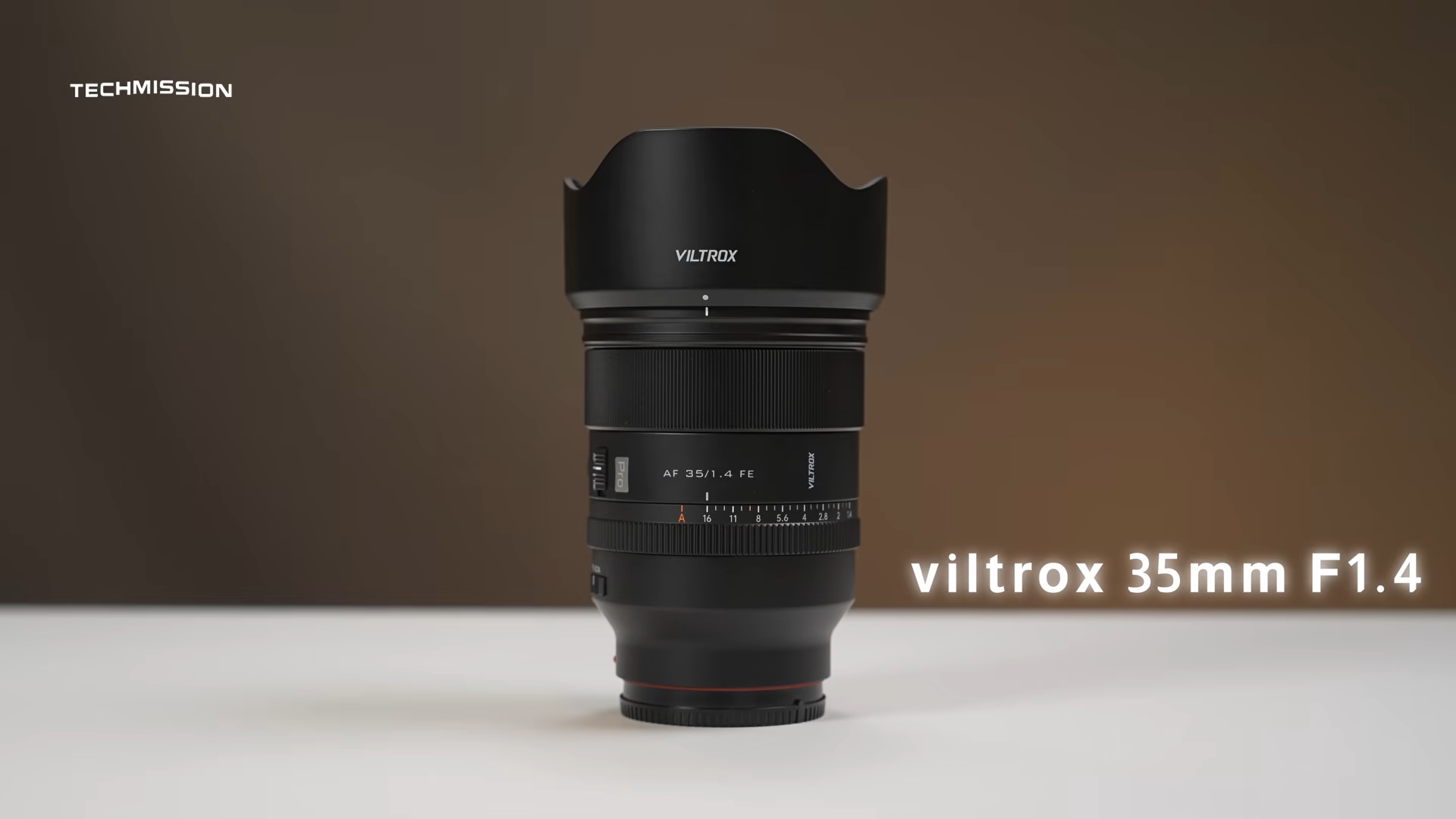
The Viltrox AF 35mm F1.4 Pro is the third full-frame Pro lens I have tested from Viltrox, following the 50mm and 85mm F1.4 models. Once again, the image quality has surprised me. It delivers the sharpness, contrast and control of optical aberrations that make me take it seriously alongside much more expensive first-party lenses.
My recommendation comes early: if you want a fast 35mm prime for environmental portraits, travel, documentary work or everyday photography, this is an excellent option. Its main compromise is its size and weight. Sony users also need to consider burst-shooting and focus-breathing-compensation limitations.
The US list price is $829, approximately the $830 quoted in my video. That is a meaningful investment, but the performance makes a strong case for it. Viltrox product information.

Why 35mm earns a place in so many camera bags
I am probably not the most habitual 35mm photographer. I often move between 24mm and 50mm, and I do not always reach for a prime in between. Yet whenever I spend time shooting at 35mm, I come away with photographs I really like.
It is an especially useful focal length when the surroundings matter as much as the person. Environmental portraits, street scenes, families, children playing and travel photography all suit this perspective. You can include enough of the setting to tell a story while keeping a clear subject in the frame.
An f/1.4 aperture adds flexibility in lower light and gives you room to separate a subject from a busy background. That combination makes a good 35mm prime useful across still photography and video.

A substantial lens with controls that make sense
This is a sizeable lens. My review sample weighed 777g on my scale, and I measured its length at approximately 115mm before the final specifications were published. Those are my own measurements, rather than official dimensions.
Viltrox now lists the Sony E version at approximately 760g and 111mm long, and the Nikon Z version at approximately 780g and 112.5mm long. Both have a maximum diameter of 84.5mm and accept 77mm filters. Sony E specifications, Nikon Z specifications.
In use, I found the weight manageable. It did not make handheld shooting uncomfortable, and I would be happy to take it travelling. Photographers who value a small, discreet kit will nevertheless want to consider the bulk carefully.
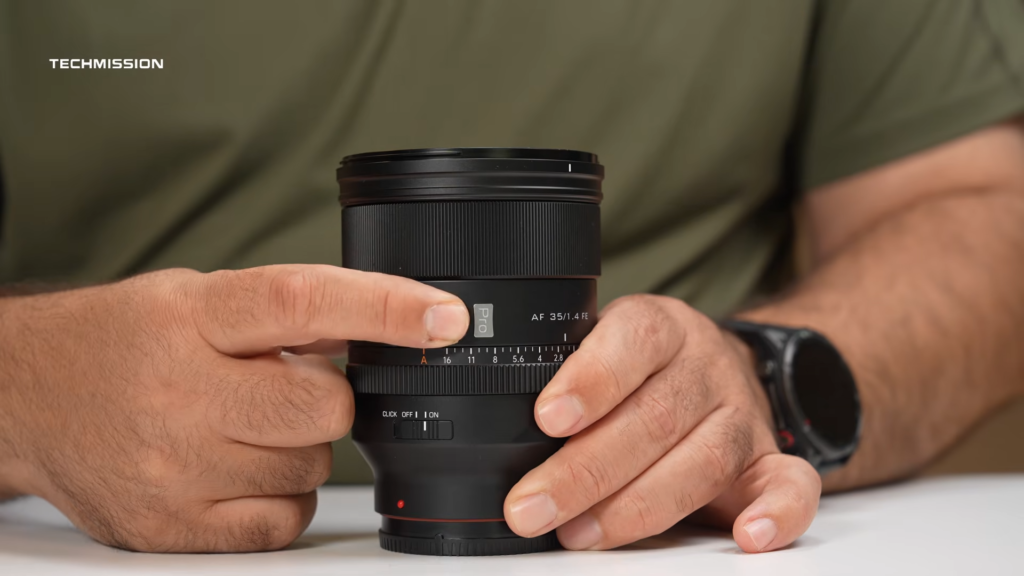
The physical controls are well judged. There is a broad focus ring, an AF/MF switch, a customizable function button and an aperture ring with a click/de-click switch. Clicked operation gives you clear aperture steps for photography; de-clicking makes smooth adjustments easier during video recording.
Manual focusing is electronic, or focus-by-wire. In my testing, it felt precise and largely linear, making deliberate adjustments straightforward.
The hood fits smoothly, and the lens has the premium feel I have come to expect from this series. There is a metal mount, a visible sealing gasket and a USB-C connection for firmware updates. Viltrox describes the production lens as having a weather-sealed metal body. Viltrox construction details.
Nine specialist elements in a sixteen-element design
The optical construction was not available when I recorded the video. We can now fill in that missing part of the review: the Viltrox AF 35mm F1.4 Pro uses 16 elements in 11 groups, including 3 extra-low-dispersion elements, 4 high-refractive-index elements and 2 ultra-precision aspherical elements. Viltrox lists the same counts for both mounts. Viltrox optical-design information.
That gives us nine specialist elements out of sixteen—just over 56% of the total. In other words, a majority of the elements are exotic, using specialized glass properties or aspherical surfaces.
The distinction matters. ED glass helps control colour fringing by reducing differences in how wavelengths focus. High-refractive-index glass gives the designer more freedom to bend light within the available space. Aspherical surfaces help correct aberrations that are difficult to manage with spherical surfaces alone, especially in a fast lens.
The element count does not prove image quality on its own. What makes this formula interesting is how well the resulting lens performed in my tests, particularly in its control of chromatic aberration and its sharpness at f/1.4.
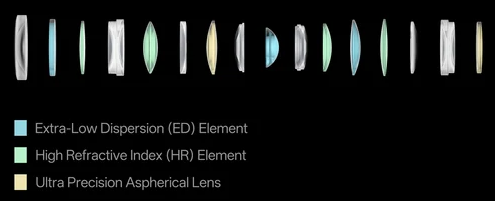
Viltrox optical diagram: cyan identifies ED elements, green identifies HR elements, and yellow identifies ultra-precision aspherical elements.
What the supplied MTF chart tells us
The supplied MTF chart adds useful context to the hands-on results. Viltrox notes that the E- and Z-mount versions can have slightly different MTF curves, so this analysis refers specifically to the plot reproduced here. Viltrox MTF explanation.
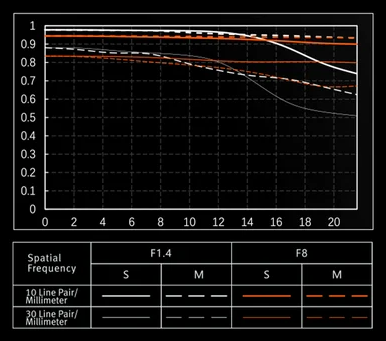
The horizontal axis runs from the image centre toward the full-frame corner, approximately 21.6mm from the centre. Higher curves indicate stronger contrast transfer at the spatial frequency being plotted. The 10-line-pairs/mm curves describe the reproduction of relatively coarse structures; the 30-line-pairs/mm curves give a better indication of fine-detail contrast.
White and grey curves represent f/1.4, while orange curves represent f/8. Solid lines are sagittal, and dashed lines are meridional: two orientations of detail whose different responses help reveal how consistently the lens renders off-axis structures.
At f/1.4, the centre is very strong. The 10 lp/mm curves start close to the top of the chart, around 0.97–0.98, while the 30 lp/mm curves begin around 0.88. That combination suggests strong central contrast with convincing fine-detail reproduction at maximum aperture.
The important qualification appears farther out. The 10 lp/mm sagittal curve drops noticeably beyond roughly 14mm image height, reaching around 0.74 near the corner, while its meridional counterpart remains above 0.9. The 30 lp/mm curves fall to approximately 0.50 and 0.63 at the outermost edge. These are visual estimates from the supplied graphic, rather than measured data points.
This is therefore a chart for a lens with excellent central performance and useful outer-frame performance wide open, but a visible reduction in fine-detail contrast toward the extreme corners. The separation between the sagittal and meridional curves also indicates that differently oriented detail is not rendered equally there. It can be associated with off-axis aberrations, although this graph alone cannot isolate their causes.
At f/8, the main benefit is greater consistency across the frame. The 10 lp/mm curves remain around 0.9 or higher toward the corner. The 30 lp/mm sagittal curve stays close to 0.8 across the image field, while the meridional curve declines to roughly 0.67 near the corner. That is a substantial improvement in the weakest wide-open corner response, particularly in the sagittal direction.
Not every central curve rises when the lens is stopped down: the plotted f/8 central values are slightly lower than at f/1.4. The useful reading is improved outer-frame consistency, rather than a universal increase in every curve. The graphic does not specify enough about its calculation or measurement conditions to explain that difference confidently.
The chart broadly supports the practical impression of a strong wide-open lens that becomes more even when stopped down. It does not establish identical sharpness from centre to corner at f/1.4, prove performance at f/4 or f/5.6, or tell us how the lens handles flare, distortion, vignetting or background blur. Those questions still require photographs and hands-on testing.
Sharp from f/1.4, with its best consistency stopped down
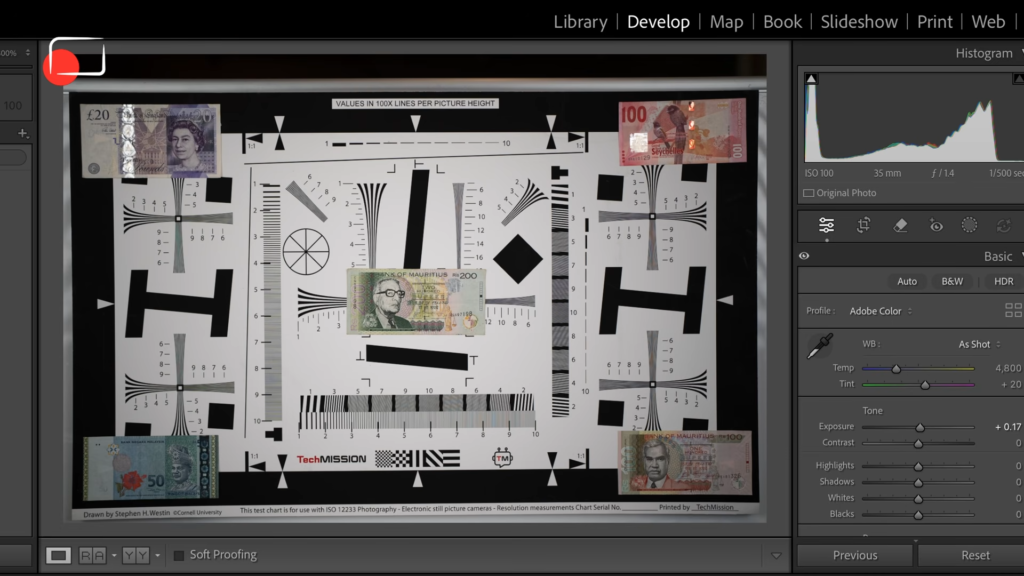
My own chart tests showed excellent central sharpness and contrast at f/1.4. The outer areas also looked very good for a fast 35mm lens, with a modest drop that I noticed more in contrast than in apparent sharpness.
At f/2.8, the outer frame improved considerably. By f/4, the image looked exceptionally even across the frame, and that strong performance continued through f/8. At f/11, I began to see a small reduction in crispness consistent with diffraction, although the results remained very good.
For landscapes and other subjects where detail across the frame matters, my preferred range is around f/4–f/5.6. I would use f/1.4 confidently when light levels, shutter speed or subject separation call for it.
Optical aberrations are impressively well controlled
Chromatic aberration was particularly difficult to find in my images. In the RAW files I examined without applying a correction profile, colour fringing was not a meaningful distraction. That is one of the strengths I have repeatedly appreciated in the Viltrox Pro lenses I have tested.
I saw a very small amount of pincushion distortion. It was subtle enough that it did not become a practical concern in my examples. Stopping down made it less noticeable in those test images, although aperture changes should not be treated as a general cure for geometric distortion.
Vignetting was also unobtrusive in my chart tests at f/1.4, becoming less of a concern as I stopped down. Some real-world photographs showed darker corner shapes that I suspect came from an incorrectly seated hood. I would distinguish those possible mechanical obstructions from the lens’s natural illumination fall-off.
These observations describe the files and conditions I examined. They are not a claim that every possible scene will be completely free of aberrations.

Fast autofocus and restrained focus breathing
Autofocus was fast, accurate and quiet in my testing. Transitions between nearby and distant subjects were smooth, and the lens responded well both to a deliberately selected focus point and to the camera’s subject-detection system.
The important result was visible when I checked the photographs afterwards: focus landed where I wanted it. That practical reliability matters more to me than a motor specification alone.
Focus breathing—the change in framing as focus distance changes—was small in my tests. It was not completely absent, but I did not find it distracting in ordinary focus transitions.
Sony users should account for the roughly 15fps ceiling with continuous autofocus discussed in my video when using this lens on bodies capable of faster bursts. The relevant issue is burst shooting with ongoing focus tracking; it should not be read as a universal limit across every focus mode and camera setting. Sony documents that continuous-shooting performance depends on the lens, focus mode and shutter configuration. Sony continuous-shooting guidance.
The Viltrox also lacks support for Sony’s in-camera breathing compensation. Sony limits that feature to compatible camera-and-lens combinations. Given the small amount of breathing I observed, this was a minor limitation for my work. Sony breathing-compensation compatibility.
Those Sony-specific restrictions should not be transferred automatically to Nikon Z. Feature availability still depends on the particular camera and firmware combination.

Attractive backgrounds and usable flare character
The background rendering is pleasing, with a smooth transition between focused and defocused areas. A 35mm lens keeps more environmental context than the longer focal lengths I usually choose for strong subject isolation, but there is still plenty of room for attractive blur.
For the strongest separation, move closer to the subject, open the aperture and allow some distance between the subject and background. That approach produced lovely results with this lens.
Flare resistance was good overall. Strong light sources could produce visible artifacts and some loss of contrast and apparent crispness, but I often found the resulting look attractive. For video or backlit portraits, that character can work creatively. For a clean, high-contrast result, it remains something to watch while framing.
Stopping down also produced attractive sunstars in my examples.
The specifications that matter in practice
| Specification | Viltrox AF 35mm F1.4 Pro |
|---|---|
| Coverage and mounts | Full-frame; Sony E and Nikon Z |
| Focal length / aperture range | 35mm / f/1.4–f/16 |
| Optical construction | 16 elements in 11 groups |
| Specialist elements | 3 ED, 4 HR, 2 ultra-precision aspherical |
| Diaphragm | 11 blades |
| Minimum focus / maximum magnification | 0.3m / 0.18× |
| Autofocus | HyperVCM; internal focusing |
| Filter thread | 77mm |
| Sony E dimensions / weight | 84.5 × 111mm / approximately 760g |
| Nikon Z dimensions / weight | 84.5 × 112.5mm / approximately 780g |
| US list price | $829 |
Production specifications from Viltrox Sony E and Viltrox Nikon Z. My review-sample measurements are described separately above. Regional prices and promotions vary.
TECHMISSION Recommends
Where to Buy the Viltrox 35mm F1.4 Pro
Some links are affiliate links — TECHMISSION may earn a commission at no extra cost to you. See our affiliate disclosure.
Should you buy the Viltrox AF 35mm F1.4 Pro?
Yes. The Viltrox AF 35mm F1.4 Pro combines excellent image quality, dependable autofocus and useful physical controls at a price I consider very reasonable for the performance.
Its results put it in the same serious conversation as premium first-party 35mm lenses. That is my judgement from using it, rather than a claim that it matches every rival in every characteristic. Weight, handling and system integration remain meaningful reasons to choose one lens over another.
For travel, environmental portraits, documentary photography and everyday storytelling, I would recommend it confidently. If your priority is a small camera bag, consider the size carefully. If you use a fast Sony body and depend on its highest burst rates with continuous autofocus, account for that limitation before buying.
For everyone comfortable with its physical size and their camera’s supported features, this is a very convincing fast 35mm prime.
Disclosure: Viltrox provided access to the lens for this review. The review was not sponsored; Viltrox did not pay for it and had no editorial input.