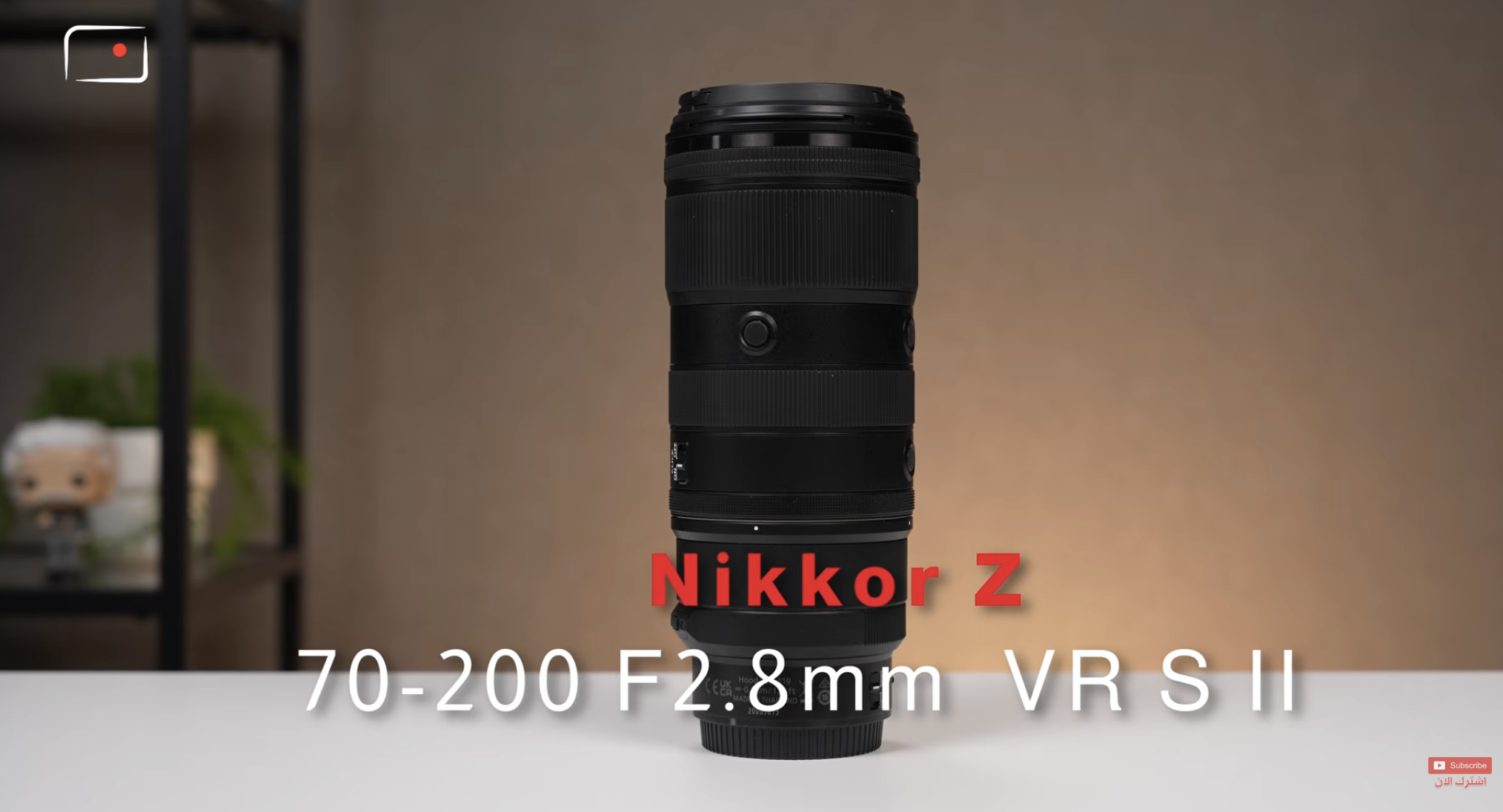
Nikkor Z 70-200mm F2.8 VR S II Review: The Mission Impossible of Refining an Already Outstanding Lens
There are some lenses that define an entire camera system, and the 70-200mm F2.8 is undoubtedly one of them.
Whether you shoot sports, wildlife, events, portraits, documentaries, or corporate work, this focal range is one of the first professional zooms photographers invest in. Nikon’s original Nikkor Z 70-200mm F2.8 VR S quickly became one of the sharpest telephoto zooms ever produced, which naturally raises an interesting question:
How do you improve a lens that was already close to perfect?
The answer is the new Nikkor Z 70-200mm F2.8 VR S II.
Rather than reinventing the lens, Nikon focused on refining nearly every aspect of the design. The result is a lens that feels more mature, more responsive, and noticeably easier to live with on a daily basis.
Smaller, Lighter, Better Balanced
The first thing you notice is not the optics—it is the handling.
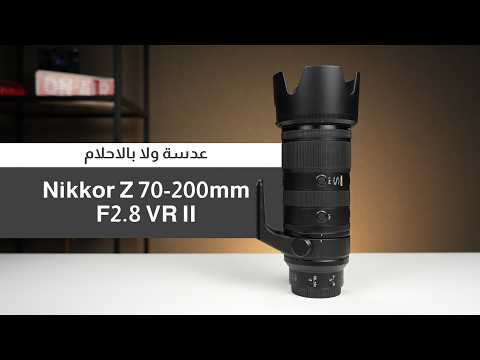
Removing the tripod foot brings the weight down to just 998 grams, roughly 26% lighter than the previous generation in practical carrying configuration. Nikon has also shortened the lens by around 12mm, bringing its dimensions to approximately 90 × 208mm.
On paper those numbers may not sound dramatic, but in daily use they make a meaningful difference.
The smaller dimensions were just enough to allow the lens to fit inside my Peak Design Everyday Sling, something the previous version struggled to do. That may sound like a small improvement, but photographers who travel or work long shooting days quickly learn that every gram and every centimetre matters.

Professional Build Quality
As expected from Nikon’s S-Line, build quality is exceptional.
The lens feels extremely solid without becoming unnecessarily heavy. The control layout is well thought out, with customizable function buttons, a dedicated focus limiter, programmable control ring, zoom ring, focus ring, and a removable tripod foot.
The lens accepts standard 77mm filters, while the redesigned hood includes a small access window that makes rotating circular polarizers considerably easier.
Nikon also fully weather-sealed the lens for professional outdoor use. While Nikon does not publish a detailed sealing diagram for every gasket, the construction clearly targets photographers working in demanding environments.
Autofocus That Simply Disappears
One of the biggest upgrades comes in autofocus performance.
The lens uses Nikon’s Silky Swift Voice Coil Motor (SSVCM) system, delivering autofocus that feels almost instantaneous. Nikon claims autofocus is approximately 3.5 times faster than the original version, and in real-world shooting I had absolutely no reason to question that claim.
Mounted on fast bodies like the Z9, autofocus is effectively flawless. Subject acquisition is immediate, tracking is reliable, and the lens never feels like the limiting factor.
Perhaps the biggest compliment I can give it is that autofocus completely disappears from your workflow—you simply stop thinking about it.
Focus breathing is also extremely well controlled, making the lens equally suitable for professional video work.

Improved Stabilization
Image stabilization has also received an upgrade.
While the previous lens was already highly capable, the newer stabilization system gives additional confidence when shooting handheld, especially toward the longer end of the zoom range or in low-light conditions.
Combined with Nikon’s in-body stabilization, handheld shooting becomes remarkably stable for both stills and video.
Optical Quality That Leaves Little to Criticize
Internally, the optical formula consists of 18 elements arranged in 16 groups, supported by Nikon’s premium Meso Amorphous, ARNEO, and Fluorine coatings.
These coatings slightly improve contrast while reducing internal reflections compared to the original lens.
Image quality is exactly what you expect from Nikon’s flagship telephoto zoom.

At 70mm
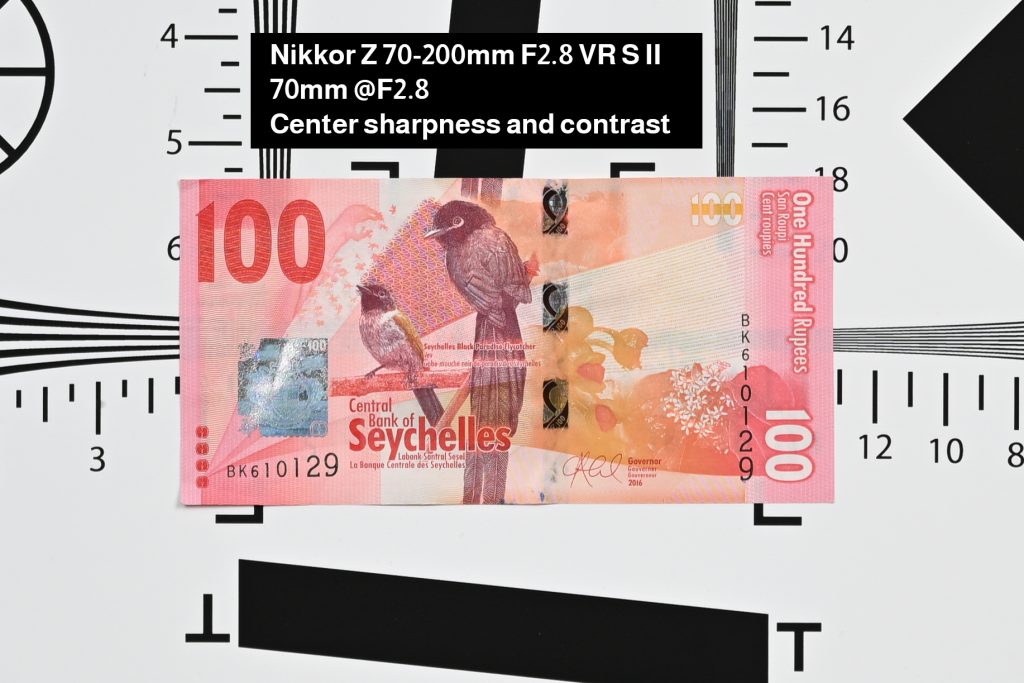
Wide open at F2.8, centre sharpness is outstanding.
More impressively, the corners are almost equally sharp, producing remarkably consistent image quality across the frame. Stop down to F4, and the lens becomes essentially flawless, with exceptional contrast and micro-detail.

Around 120mm
Performance remains virtually unchanged.
Centre sharpness stays excellent, while the corners become only marginally softer—something that would rarely be noticeable outside laboratory testing.
At 200mm
The longest focal length is often where telephoto zooms begin to struggle.
Not here.
At 200mm F2.8, the centre remains exceptionally sharp, while the corners retain nearly the same level of performance. This consistency across the zoom range is one of the lens’s greatest strengths.
Compared to the original version, the improvements are measurable but subtle. That is not a criticism of the new lens—it simply reflects how extraordinarily good the first-generation lens already was.

Close Focusing
One of the pleasant surprises is the close focusing capability.
The lens focuses as close as 38cm at 70mm and 80cm at 200mm, allowing photographers to capture detailed close-up images without switching lenses.
Sharpness remains excellent even at minimum focusing distances, while chromatic aberration stays extremely well controlled with only very slight traces of purple fringing in demanding situations.
Distortion, Vignetting and Chromatic Aberration
Optically, there is very little to complain about.
At 70mm, there is only mild barrel distortion accompanied by slight vignetting.
Around 90mm, distortion is effectively absent.
At 200mm, a small amount of pincushion distortion appears together with somewhat stronger vignetting, although both are easily corrected automatically by modern Nikon bodies or raw converters.
Chromatic aberration is exceptionally well controlled throughout the zoom range and is rarely visible in real-world photography.
Bokeh
Nikon upgraded the aperture mechanism from 9 blades to 11 blades, producing smoother out-of-focus rendering.
The result is exactly what photographers expect from a premium 70-200mm F2.8.
Background separation is beautiful, transitions are smooth, and highlights maintain an attractive rounded shape across much of the aperture range.
Quite simply, the bokeh is delicious.

The One Weak Spot
If there is one area where I expected better performance, it is flare resistance.
Under strong backlighting, the lens can produce more flare and contrast reduction than I would like to see from a premium optic in this price category.
It is not a deal breaker, and careful shooting angles often minimise the issue, but it remains the weakest aspect of an otherwise outstanding optical design.
TECHMISSION Recommends
Where to Buy the Nikkor Z 70-200mm f/2.8 VR S II
Some links are affiliate links — TECHMISSION may earn a commission at no extra cost to you. See our affiliate disclosure.
Final Verdict
The Nikkor Z 70-200mm F2.8 VR S II is exactly the kind of second-generation product Nikon needed to make.
It does not attempt to revolutionize an already excellent lens. Instead, it improves almost every aspect that photographers actually experience in daily use: weight, handling, autofocus, stabilization, coatings, and overall usability.
Image quality is spectacular, autofocus is among the best currently available, and the lens pairs perfectly with Nikon’s flagship cameras, including the Z9.
My only real reservation is the price.
At well over US$3,100, this is an expensive investment for what many professionals consider an essential workhorse lens. That price inevitably pushes some photographers toward increasingly capable third-party alternatives, including the Tamron 70-200mm for Z mount and the upcoming Sigma equivalent.
If budget is not a concern, this is arguably the finest 70-200mm Nikon has ever produced.
If budget does matter, the decision becomes much harder—especially considering just how excellent the first-generation lens already was.
Pros
- Outstanding sharpness across the zoom range
- Extremely fast and reliable autofocus
- Noticeably lighter and better balanced
- Excellent stabilization
- Minimal focus breathing
- Beautiful bokeh
- Superb overall build quality
Cons
- Premium price
- Flare resistance could be better
- Optical improvements over the original are relatively modest, but then again the original did not really need improvement.
Should You Buy It?
Buy it if
You are a professional photographer or serious enthusiast shooting sports, wildlife, weddings, events, portraits, or documentaries, and you want the very best native 70-200mm lens Nikon currently offers. The combination of outstanding image quality, lightning-fast autofocus, improved stabilization, excellent handling, and reduced weight makes this an exceptional everyday workhorse for the Z system.
Skip it if
You already own the original Nikkor Z 70-200mm F2.8 VR S and are satisfied with its performance. The original is still a solid performer. The Mark II is undeniably better, but the improvements are evolutionary rather than revolutionary. Considering its price of over US$3,100, the upgrade is difficult to justify unless you genuinely value the reduced weight, faster autofocus, and improved handling. The premium price also makes increasingly capable third-party alternatives from Tamron—and soon Sigma—worth considering if budget is a significant factor.